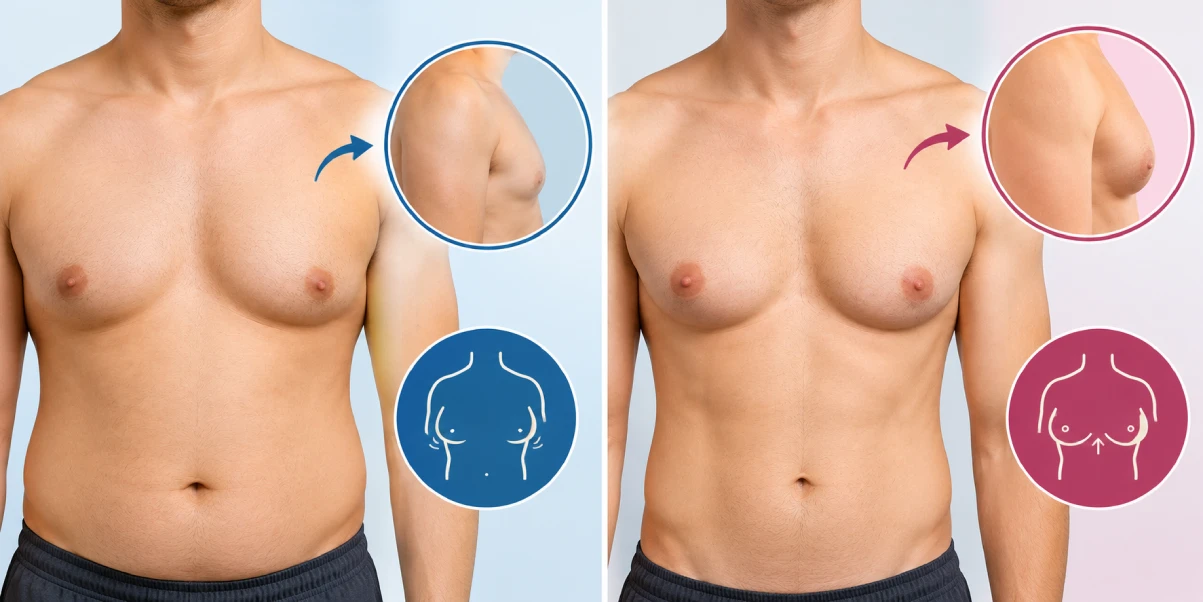

Most men often feel confused by the presence of noticeable excess chest fat and seek ways to eliminate it.
Not every fat or swelling in your chest area is Gynecomastia. It can be chest fat, a common yet harmless condition many men face.
However, the confusion is common to arise as they both look very similar at first glance, such as enlarged chests, loss of contour, and sometimes even mild discomfort.
But their causes and treatments are very different.
Gynecomastia occurs from a hormonal imbalance, while chest fat is simply fatty buildup caused by weight gain or poor lifestyle habits.
Knowing which one you are actually dealing with is critical to identify the ways to fix it, and whether and when you need a surgical procedure.
This blog will take a closer look at both of them.
What is Gynecomastia?
To give you a quick overview, Gynecomastia is a medical condition or a hormonal imbalance. Men with Gynecomastia develop excess glandular breast tissue. This provides the chest with a fuller or more feminine appearance.
It occurs due to an imbalance between the two hormones estrogen and testosterone, where estrogen levels become relatively higher.
Natural factors like puberty, ageing, certain medications, or any underlying health conditions can make this happen.
It is important to note that it differs from regular fat and feels firm or rubbery under the nipple. It doesn't reduce much even after weight loss or exercise.
It can affect one or both sides of the chest and can sometimes cause tenderness or sensitivity around the nipples.
While there is nothing to worry about in medical terms, it can be emotionally distressing. This is the reason why most men seek professional evaluation or gynecomastia surgery in Delhi.
What is chest fat (pseudogynecomastia)?
Chest fat is a regular fat accumulated in the chest area. Medically referred to as pseudogynecomastia, it occurs due to the growth of fat and not glandular breast tissue.
Typically, it develops due to overall weight gain, poor diet, or lack of physical activity.
Overweight men are most likely to have this condition. The accumulated fat feels soft and evenly spread across the chest.
It can be reduced with exercise, diet changes, or fat reduction routines, which also means surgery is rarely needed.
However, it is important to note that it can be emotionally stressful, similar to Gynecomastia, affecting appearance and confidence.
Key differences: Gynecomastia vs. chest fat
| Aspect | Gynecomastia | Chest Fat (Pseudogynecomastia) |
| Cause |
Caused by a hormonal imbalance between estrogen and testosterone |
Caused by fat accumulation due to weight gain, poor diet, or inactivity |
| Tissue type | Involves glandular breast tissue growth | Consists of fatty tissue only |
| Texture and feel | Feels firm or rubbery, with a noticeable lump under the nipple | Feels soft and evenly spread like normal fat |
| Pain or tenderness | May cause tenderness or sensitivity in the nipple area | Usually painless, unless due to skin friction |
| Appearance | Often appears round and puffy around the nipples, sometimes uneven | Chest looks broad or saggy, with fat evenly distributed |
| Response to exercise |
Does not shrink significantly with workouts or diet |
Reduces with regular exercise and healthy eating |
| Diagnosis | Confirmed through medical evaluation or ultrasound | Identified through physical examination and weight analysis |
| Treatment approach | May require surgery (male breast reduction) to remove glandular tissue | Usually improves through fat loss, diet, and strength training |
Also Read: Gynecomastia vs. Chest Fat: How to Tell the Difference
How to know which one you have?
It is important to know what your accumulated fat in the chest area means. At first glance, they both cause visible chest enlargement; however, there are a few simple ways to identify whether you have Gynecomastia or chest fat.
- Touch test: Gently touch or press around your nipple area. If there is a firm, rubbery lump directly beneath the nipple, then most likely you have Gynecomastia. In contrast, if the area feels soft and even, it might be just chest fat.
- Weight change observation: Try weight loss and observe changes. Try to lose a few kilos with exercise or diet, and see what happens. If your chest size reduces noticeably, then it was just chest fat that can be reduced with weight loss. However, if it remains unchanged, it might be glandular tissue, and you require medical attention.
- Nipple shape and texture: In the case of gynecomastia, the nipples often look puffy or swollen. In contrast, in the case of chest fat, it typically spreads evenly across the chest.
- Pain or tenderness: With Gynecomastia, mild sensitivity or soreness is common, while chest fat is usually pain-free.
- Professional evaluation: Do not rely on your assumptions completely; consult a healthcare professional, such as a plastic surgeon or endocrinologist, for an accurate diagnosis. They may recommend an ultrasound or hormone test to confirm the underlying cause.
When is surgery needed?
Surgery is generally the last option considered to eliminate Gynecomastia.
Most men decide to undergo the surgical procedure when Gynecomastia does not respond to lifestyle changes, medications, or hormone management.
You may need surgery if you experience:
- A firm lump or persistent swelling that is not going away or reducing with weight loss.
- If you experience discomfort, tenderness, or tightness in the chest area
- If there is a noticeable puffiness or projection of nipples even after weight loss
- If you feel emotional distress or self-consciousness due to your chest appearance
The surgical process generally involves liposuction to remove fat and gland excision to remove breast tissue. Overall, this entire process gives a flatter and more masculine chest.
Additionally, the best part is that it is a safe and minimally invasive option.
Also Read: Gynaecomastia: Causes, Symptoms, and Treatment Options
Conclusion
Understanding the difference between Gynecomastia and chest fat is crucial to identifying the right solution. It is common to confuse these two as they may look similar, but their causes and treatments are way too different. Gynecomastia is a medical condition that occurs from hormonal imbalance, and most often requires surgery to eliminate its effects. At the same time, chest fat is just fat that can be reduced with exercise and diet.
If you have visible fat in your chest, but are unsure what it really means, consult a professional at Langersclupt.
Frequently Asked Questions
1. What is the cost of gynecomastia surgery in Delhi?
The gynecomastia surgery cost in Delhi typically ranges between Rs. 50,000 – Rs. 1,50,000. The total cost still depends on several factors, like the experience of the surgeon, the city of the clinic, the facilities available at the clinic, and the grade of Gynecomastia you have. In case of larger or more complex cases, the cost may be slightly higher.
2. Can exercise or diet reduce Gynecomastia?
Yes, exercise and diet can help reduce chest fat. However, true Gynecomastia that is generally caused by glandular tissue doesn't go disappear with workouts alone. In case the swelling persists even after weight loss, surgery or medical treatment may be required.
3. Is gynecomastia surgery safe?
Yes, it is completely safe to undergo gynecomastia surgery, but only when performed by a certified plastic surgeon. It is a short and minimally invasive procedure that comes with a quick recovery and long-lasting results.
4. How long does recovery take after gynecomastia surgery?
Within 3-5 working days after surgery, most patients can return to daily activities. However, heavy exercise or chest workouts should be avoided for at least 3-4 weeks.
5. Can Gynecomastia come back after surgery?
Well, in most cases, Gynecomastia does not return if the glandular tissue is fully removed. However, it can recur if hormonal imbalance, steroid use, or certain medications continue after the procedure.