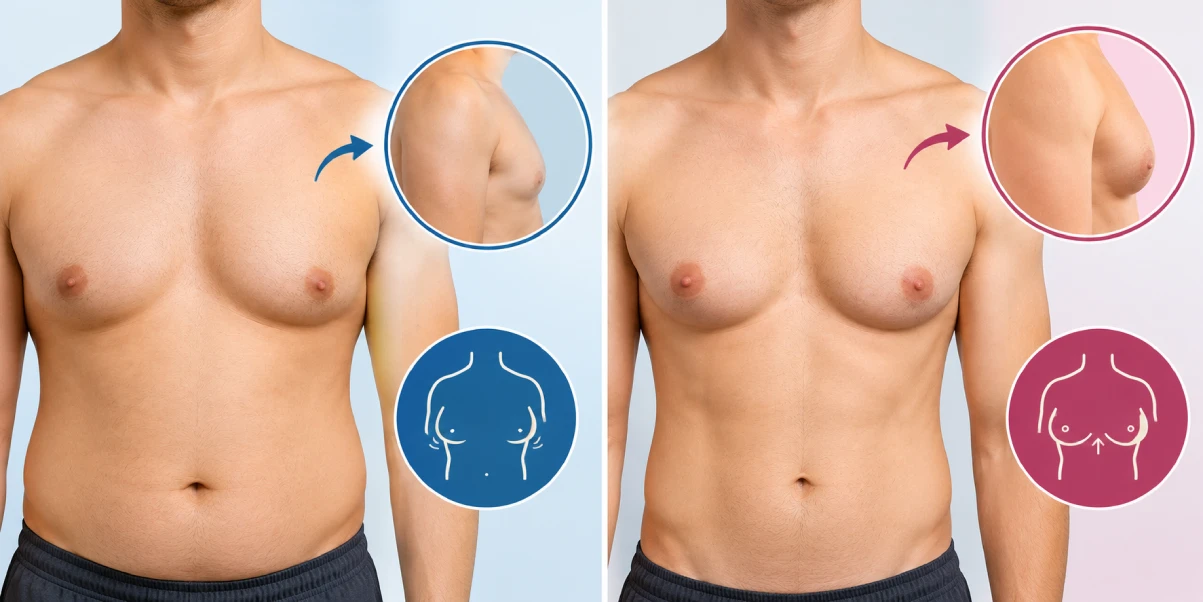

Gynaecomastia, the enlargement of the male breast tissue, is a common condition that raises concern in men. This condition is hardly ever talked about, which makes it a subject of social stigma.
It can occur at any stage of life, from newborn to adult. It is mostly a benign condition; however, it can also cause emotional distress, self-consciousness, along with physical uneasiness.
Knowing the causes, symptoms, and treatment options available is essential, as this can help you in informed decision-making along with proper treatment.
In this blog, you will learn about understanding the reasons for its occurrence, the science behind it, how it can be treated, and the options a person has: surgical and medical.
What is Gynaecomastia?
An excess of estrogen and a lack of testosterone can cause an enlargement of the breast tissue. This condition is referred to as gynaecomastia. Estrogen allows breast tissue to develop, while testosterone lessens the chances of this occurring. When the balance is tilted in favour of estrogen even the slightest, then breast tissue can grow.
It is essential to understand that pseudogynaecomastia is completely different from gynaecomastia. It is a condition that results from the deposition of fat in the chest area, which is mostly associated with obesity. Breast tissue growth leads to what is referred to as true gynaecomastia.
Causes of Gynaecomastia
The development of gynaecomastia has several potential causative factors which can be classified as physiological or anatomical, pathological, lifestyle factors, or caused by medication.
Physiological Causes
- Newborns: Some male babies present with enlarged breast tissue during the neonatal period due to the effect of maternal estrogen crossing the placenta. This condition is self-limiting during the first few weeks of life.
- Adolescence: During the time of puberty, hormone levels rise rapidly. This can cause the temporary enlargement of male breast tissue, which is colloquially known as gynaecomastia. It is self-limiting and usually resolves over a period of 6 to 24 months.
- Older Age: Gynaecomastia is more prevalent in men with positive body fat due to the increase in estrogen breast tissue after the body changes that occur with menopause.
Pathological Causes
- Hormonal Disorders: The occurrence of gynaecomastia due to hormonal diseases such as hypogonadism, hyperthyroidism, or the presence of some testicular neoplasms is more common.
- Chronic Diseases: The occurrence of gynaecomastia is more common in patients with declining health due to liver disease, kidney failure, and malnutrition.
- Genetic Conditions: The presence of some genetic conditions, such as Klinefelter's syndrome, characterized by low testosterone levels, is strongly correlated with gynaecomastia.
Lifestyle and Environmental Factors
- Substance Use: The presence of a subclass of breast tissue as a normal component of the male breast is gynaecomastia. It can be initiated with the use of alcohol, anabolic steroids, marijuana, heroin, or some types of stimulants.
- Obesity: Gynaecomastia is more common in men with positive body fat due to the increase in breast tissue after the body changes that occur with menopause.
Medication-Induced Gynaecomastia
A number of prescription and non-prescription medications have the potential to cause side effects, including breast enlargement. Some of the most common offenders are listed below.
- Anti-androgens (for prostate conditions)
- Some Heart Medications (e.g. spironolactone, calcium channel blockers)
- Some classes of Antibiotics and Antifungals
- Some Chemotherapy agents
- Some Antidepressants and Anti-Anxiety medications
Symptoms of Gynaecomastia
While breast enlargement is the hallmark symptom, gynaecomastia is not limited to breast enlargement and may present with varying degrees of severity.
Physical Symptoms
Breast tissue enlargement that is usually symmetrical, but can vary, with one side larger than the other
- A rubbery or firm tissue area below the nipple
- Sensitivity or tenderness
- Chest fullness
- Some nipple discharge in rare cases
Psychological Symptoms
- Feeling embarrassed and self-conscious
- Social isolation and avoidance of certain activities
- Anxiety and low confidence, with almost always negative feelings about the body
Due to the fact that emotional impacts can be just as serious as physical impacts, this means that recognition and consultation with a medical professional is key.
How is Gynaecomastia Diagnosed?
Diagnosis will most likely begin with a physical examination as well as taking a detailed history. The doctors will appreciate the size of the breast tissue and ascertain the presence of tenderness. They will inquire about the patients' lifestyle, substance use, and medications. Additional investigations may include:
- Blood tests assessing hormonal levels.
- Ultrasound or a mammogram helps differentiate between fatty tissue and glandular tissue.
- A biopsy (very rare) is done with worry of breast cancer, which is quite rare in men.
How is Gynaecomastia Treated?
The treatment is based on the preliminary diagnosis, symptoms, and the way the patient's life is affected. Either treatment or surgical interventions are appropriate.
Observation and Lifestyle Changes
- In some cases, pubertal gynaecomastia tends to spontaneously resolve within a 1-2 year time frame.
- In instances of pseudogynaecomastia, minimal amounts of weight loss are effective.
- In cases of worsening symptoms, the cessation of alcohol, anabolic steroids and recreational drugs is effective.
Medical Treatments
In some cases, the implementation of strategies causes a considerable amount of anxiety and stress; thus, medications are necessary.
- One of the medications that can be ordered for the patient is a Selective Estrogen Receptor Modulator (SERM) such as Tamoxifen, which is able to reduce the size and tenderness of breast tissue.
- The use of Anastrozole as an aromatase inhibitor is also medicinal to limit the amount of estrogen that is produced.
- In cases of men with low testosterone, androgen therapy is conducted.
These medications work best when started early, but even then, they are not appropriate for everyone.
Surgical Treatments
For severe and persistent situations that are psychologically disabling, surgery can provide a permanent solution. These options include:
- Liposuction: This option is most beneficial and may be performed along with pseudogynaecomastia surgery or in mixed cases. It is helpful in the removal of excess fatty tissues.
- Mastectomy (Subcutaneous Mastectomy): This method is associated with the removal of the breast tissues and is performed through small incisions. Scarring from the operation is usually very minimal.
- Combination Surgery: This is a more aggressive dual method of treatment that involves both surgical excision and liposuction. It is useful in cases of more marked enlargement that require more extreme measures.
Conclusion
Besides psychological and social issues, gynaecomastia is more prevalent than most people think and, in most cases, harmless. It is a condition that stems from an imbalance in the levels of estrogen and testosterone because of natural life stages, diseases, medications, or lifestyle changes.
There is a range of treatments from observation and medical therapy to surgeries, all of which are effective. However, the main issues is, the condition is such that it goes unnoticed most of the time. It is crucial to understand that both the psychological and emotional aspects of the condition need to be dealt with.
If you are a man suffering from gynaecomastia, the stigmata surrounding the condition should be the least of your concerns. Rest, the answer is here. Guidance and treatment are all that is needed to help you regain your confidence, comfort, and peace of mind.
Book Your Consultation with Langersculpt Today!
Living with gynaecomastia can affect not just your appearance, but also your confidence and daily life. So, if you are also experiencing this, book your consultation with expert doctors at Langersculpt. We provide safe and effective treatment options that restore a natural, masculine chest contour.
Book your consultation today and take control of your transformation with Langersculpt.