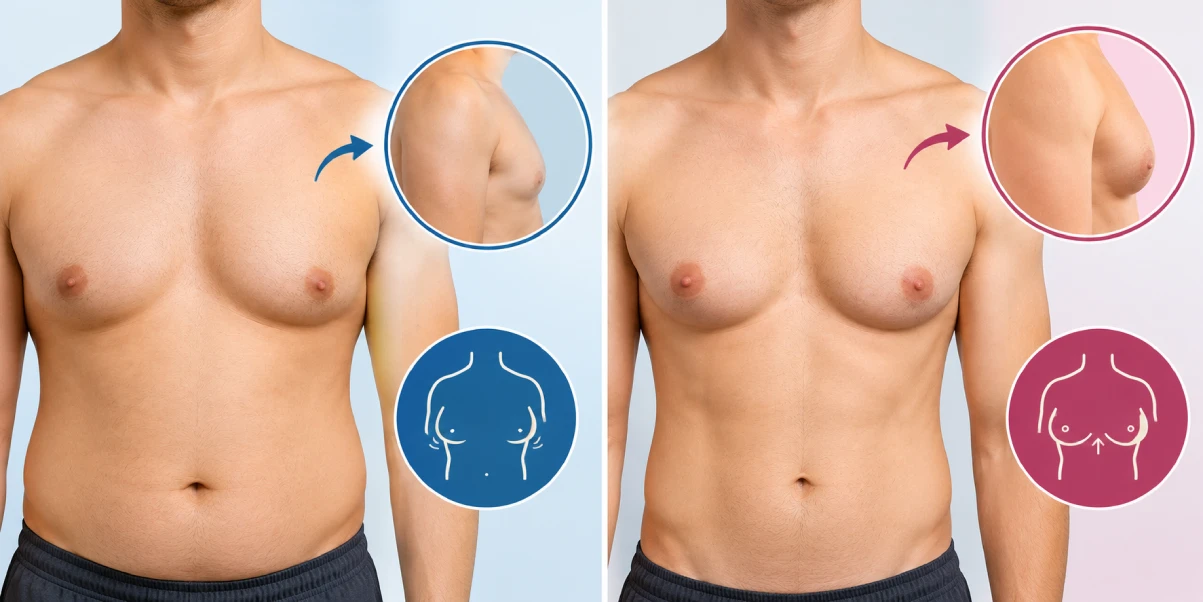
This is one of the most common questions men ask me, usually after months of frustrated gym sessions that didn't touch their chest. Here's how to actually tell the difference.
The core distinction
Chest fat is fat - soft, uniform, and spread across the pectoral area, just like fat anywhere else on the body. Gynecomastia is enlargement of actual glandular breast tissue underneath the nipple, sometimes combined with fat. They can look similar from a distance but feel very different, and they respond very differently to exercise.
The simple home test
Lie flat on your back. Pinch the tissue directly behind the nipple between your thumb and finger.
- If it feels soft and spreads out evenly, like pinching fat elsewhere on your body — that's likely chest fat.
- If you feel a firm, rubbery disc or button-like lump directly under the nipple that doesn't flatten when you lie down — that's likely glandular tissue, i.e., gynecomastia.
This isn't a diagnosis, but it's a genuinely useful first indicator.
Other signs pointing to gynecomastia
- Puffiness concentrated right under the nipple rather than spread across the chest
- Tenderness or sensitivity in the area (common, especially if it developed during puberty or from medication/hormonal changes)
- It hasn't changed despite significant weight loss or a consistent workout routine
- Asymmetry — one side more prominent than the other, which is very common with true gynecomastia and less typical of general fat distribution
Grading matters
Gynecomastia is usually classified into four grades — from a small amount of glandular tissue with no excess skin (Grade 1) to significant tissue with noticeable skin laxity (Grade 4). The grade affects treatment: mild glandular cases sometimes respond to liposuction alone, while higher grades with a lot of true gland or loose skin usually need gland excision, sometimes combined with skin reduction.
Why exercise alone often fails?
You cannot spot-reduce glandular tissue with exercise, it isn't fat, so it doesn't respond to calorie deficit or chest workouts the way fat does. Working out can reduce the fat component and improve underlying chest muscle definition, which sometimes helps mild cases look better, but if there's a real glandular component underneath, it will still be there after the fat is gone. This is exactly why so many men train for a year, get lean everywhere else, and still have a visibly enlarged, firm area under the nipple.
When to see a doctor?
If self-exam suggests a firm lump, if it's tender, if it's asymmetric, or if it hasn't budged despite genuine fat loss elsewhere — get it examined. A doctor will usually do a physical exam and occasionally an ultrasound to confirm gland vs fat vs (rarely) something that needs separate investigation, and will grade it if it is gynecomastia.
Bottom line: the pinch test is a good starting point, but the real answer comes from a proper clinical exam. Don't spend another six months in the gym guessing.
— Dr. (Col.) Vijay Langer, Double Board Certified, Gold Medalist, DNB (Plastic Surgery)
The Chest That Wouldn't Change: What 25,000 Surgeries Taught Me About Gynecomastia?
There's a particular kind of frustration I see almost every week in my clinic. A young man walks in — often mid-20s, sometimes younger — and he's clearly not out of shape. He's been in the gym for a year, sometimes two. His arms are defined, his waist is down, his diet is dialled in. And yet he's sitting across from me with his shirt still on, because the one part of his body that hasn't changed at all is his chest.
This is gynecomastia, and it is one of the most misunderstood conditions I treat.
The myth that costs men years
Somewhere along the way, we all absorbed the idea that any excess on the body is "just fat," and that fat responds to effort — enough discipline, enough deadlifts, enough clean eating, and it goes away. For most of the body, that's broadly true. For true gynecomastia, it is not, and this single misunderstanding costs men years of wasted effort and, frankly, a lot of self-esteem.
Gynecomastia isn't fat. It's glandular breast tissue — the same type of tissue every person has in small amounts, but enlarged, usually due to a hormonal imbalance at some point in life: puberty, certain medications, anabolic steroid use, liver or thyroid conditions, or sometimes no identifiable cause at all. It sits directly behind the nipple, and unlike fat, it does not shrink with a calorie deficit. You can get shredded everywhere else on your body and it will still be sitting there, firm and unchanged.
How to actually tell the difference?
I always tell patients to do a simple test before they come in: lie flat on your back and pinch the tissue right behind the nipple. Fat spreads out softly between your fingers, the same way it would anywhere else on your body. Glandular tissue feels different — firmer, more like a coin or a small disc, and it holds its shape rather than flattening out.
It's not a diagnosis. But it's usually the first moment a man realizes that what he's been fighting isn't something his workout program was ever going to fix.
Why this matters more than people think?
I've operated on men in their late 40s who tell me they've avoided pools, tight t-shirts, and physical intimacy for two decades because of this. I've also operated on 19-year-olds whose gynecomastia appeared during puberty and simply never resolved, and who assumed, quietly, that this was just their body — something to live with rather than something treatable.
That's the part that stays with me after all these years. It's not really about vanity. It's about men who've spent an enormous amount of energy on something within their control — fitness, discipline, effort — directed at a problem that was never going to respond to that effort in the first place. The frustration isn't really about the chest. It's about doing everything "right" and still not seeing the result.
What actually works?
For genuinely mild cases where the fat component is dominant and the gland is minimal, liposuction alone can be enough. For true glandular gynecomastia — the firm tissue that doesn't move regardless of body fat percentage — surgical excision of the gland is the only real fix, sometimes combined with liposuction to smooth the surrounding contour, and in more advanced cases with skin laxity, some skin reduction as well.
It's a relatively quick procedure with a short recovery, usually a day-care surgery, and the psychological shift I see in patients afterward — the first time they take their shirt off at a beach without thinking about it — is one of the more rewarding outcomes in this field.
The point of this piece
If there's one thing I want a man reading this to take away, it's this: if you've put in genuine, sustained effort and your chest hasn't changed, the problem probably isn't your effort. It's not a discipline issue, and it's not something more push-ups will solve. It's worth getting a proper exam before spending another year assuming otherwise.
— Dr. (Col.) Vijay Langer
35+ years in plastic and cosmetics surgery, 25,000+ surgeries performed.